
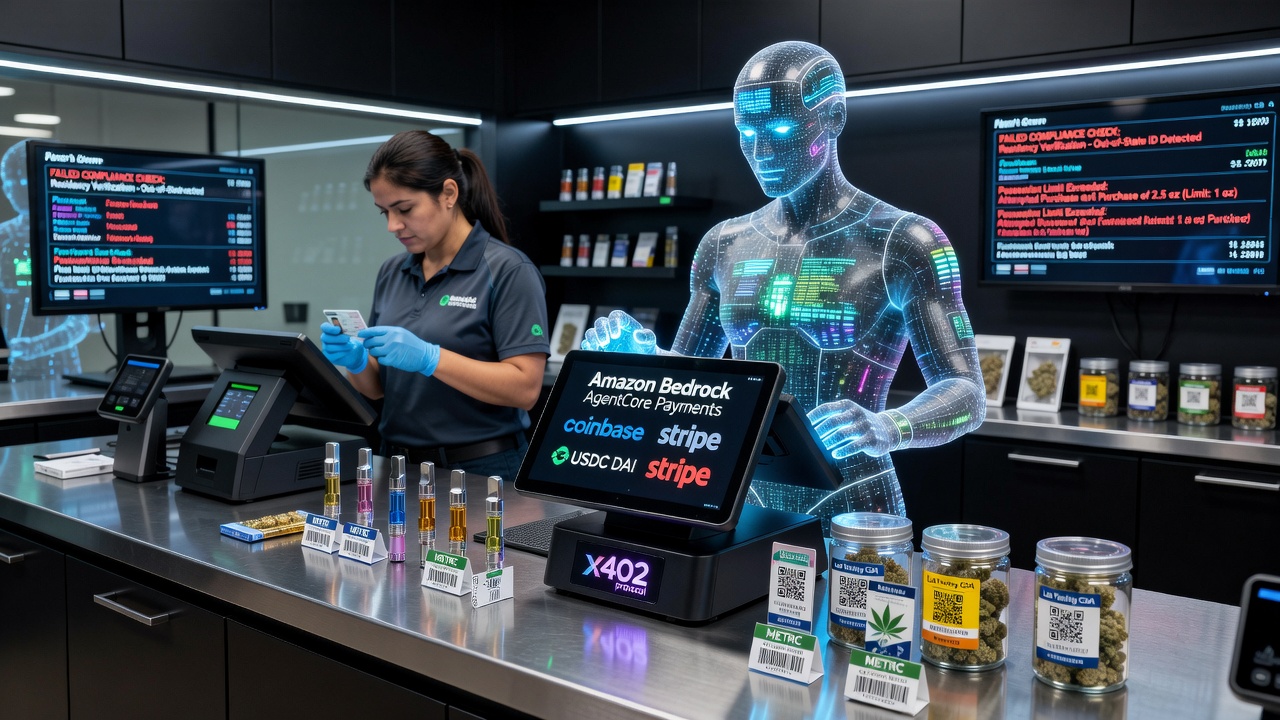
Amazon's new Bedrock AgentCore Payments system, built with Coinbase and Stripe, lets AI agents find paid services, verify who they are, and settle transactions using stablecoins and the x402 protocol - all within spending limits set in advance. That sounds like a distant fintech story until you consider what it signals for any regulated retail category that runs on tight compliance rails, strict age verification, and cashless-payment workarounds. Cannabis retail is exactly that category, and operators should be paying attention now, not after agentic commerce shows up at the point of sale.
Why this matters for a plant-touching business
Dispensaries already operate inside one of the most constrained payment environments in American retail. Federal illegality keeps most national card networks at arm's length, forcing operators toward cashless ATM workarounds, closed-loop debit systems, or straight cash handling - each with its own compliance headaches and shrinkage risk. An AI agent that can discover a paid service, authenticate itself, and pay autonomously with stablecoins is a payment rail that, in theory, sidesteps the traditional banking chokepoints that have squeezed cannabis retail for a decade. That's the appeal. The catch is that nothing about agentic payments solves the underlying problem: cannabis purchases require verified legal age, verified legal residency in some medical programs, and a paper trail that satisfies state seed-to-sale tracking systems like METRC. An autonomous agent paying for a vape cartridge or a flower SKU doesn't automatically satisfy any of that.
Authorization is not the same as compliance
Spending limits and preset authorization - the core promise of AgentCore Payments - answer a fraud question, not a regulatory one. A mandate can prove a buyer authorized up to a certain dollar amount. It cannot prove the buyer is 21, that the delivery address sits inside a licensed service area, or that the purchase doesn't exceed a state's possession limits. For dispensary operators already juggling compliant packaging requirements, lab testing disclosures, and COA availability at the point of sale, an agent-driven order flow adds a layer of identity and legal-capacity verification that card networks and stablecoin rails were never built to handle. Regulators who are only now writing rules for human-operated delivery and curbside pickup have given no indication they're ready to address non-human purchasing agents.
What operators and software vendors should watch
None of this means cannabis retailers need to chase agentic commerce today. It does mean the point-of-sale and e-commerce vendors serving the industry - the Dutchie, Jane, and Flowhub-style platforms operators rely on daily - will eventually face pressure to decide whether AI-driven orders get accepted at all, and under what verification standard. A few practical considerations for operators and MSOs:
- Age and ID verification cannot be delegated to a payment agent; it has to happen at a point humans can audit.
- State tracking systems expect a transaction record tied to a verified purchaser, not an autonomous intermediary.
- Stablecoin settlement introduces new questions for 280E accounting and excise tax remittance that haven't been tested by any state tax authority.
- Wholesale and B2B ordering between licensed operators is a more plausible near-term use case than consumer-facing agentic checkout.
In practice, though, the bigger lesson from Amazon's move isn't about cannabis specifically - it's about how fast payment infrastructure is evolving around assumptions that regulated industries simply don't meet. Cannabis compliance teams spend their days reconciling inventory shrinkage, wholesale pricing sheets, and tax bills under rules that still treat the plant as an outlier in American commerce. An AI agent with a wallet and a spending cap doesn't change any of that. If anything, it sharpens the case for why cannabis retail needs its own verification standards before anyone starts talking about autonomous purchasing at the counter.