
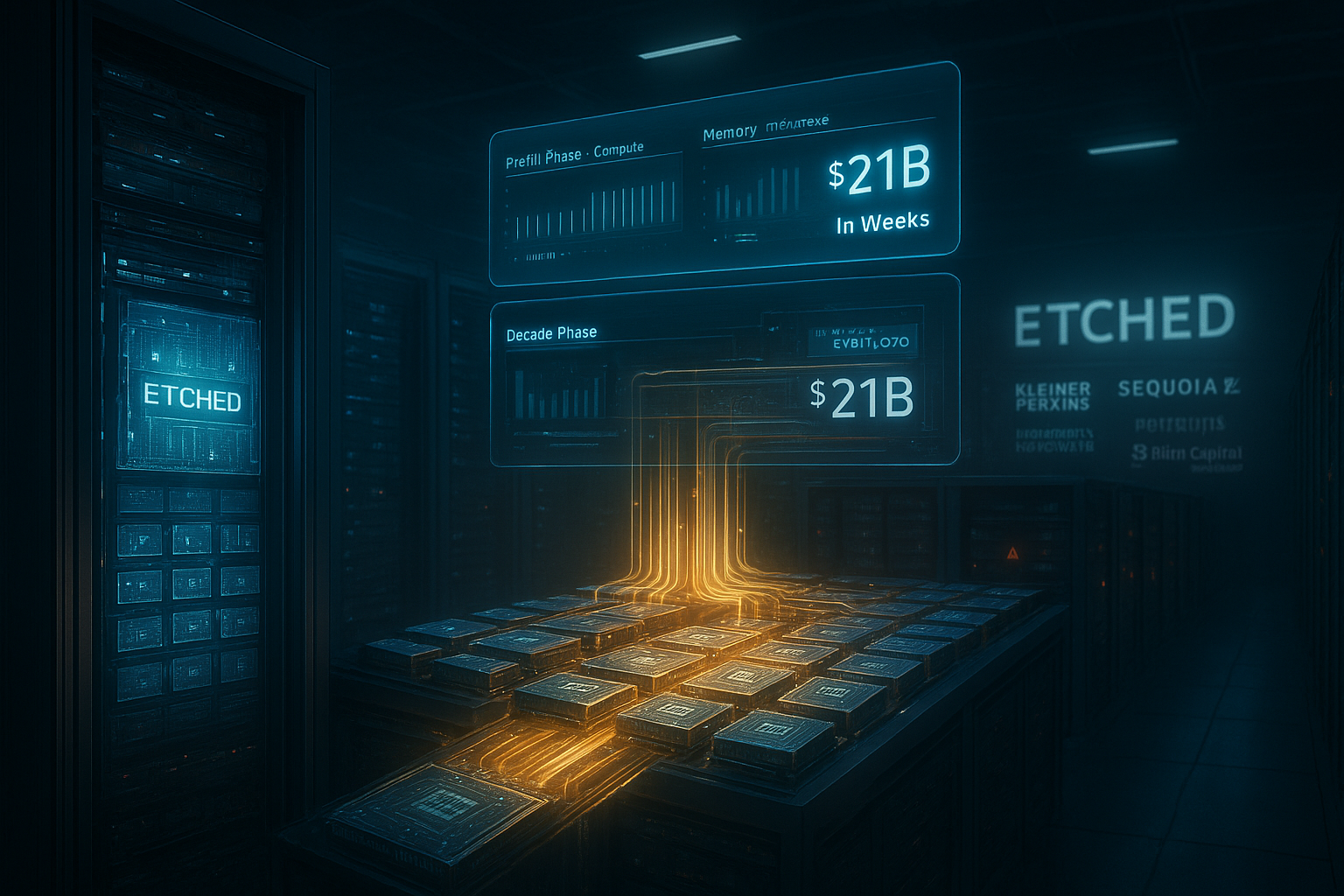
Etched, a startup building specialized hardware for AI inference, announced Tuesday it raised $700 million at a $21 billion valuation, led by quantitative trading firm Jane Street. The jump is notable mainly for its speed: Etched was valued at $5 billion in December, then $10.3 billion in July after a $300 million Series C. A month later, investors pushed that figure to $21 billion - an increase of nearly $11 billion in roughly thirty days.
What's driving the enthusiasm, according to co-founder and COO Robert Wachen, is Etched's decision to redesign two components of the inference pipeline from the ground up rather than iterate on existing chip architectures. Inference - the computation that happens after a user submits a prompt - splits into two phases: prefill, which is compute-intensive and handles context, and decode, which is memory-intensive and generates the actual output tokens. Etched built a low-voltage prefill chip that packs in more transistors without the heat penalties typical of high-end AI silicon, and it developed what it calls cluster-scale memory, an interconnect that lets multiple chips share a single fast memory pool. This is a different kind of infrastructure bet than, say, the regional software rollouts operators track in state-specific markets - the kind of localized systems seen with dispensary software arizona deployments - but the underlying logic is the same: specialized tools built for a specific workload tend to outperform general-purpose ones once the workload is well understood. dispensary software arizona
Why the Jane Street Endorsement Matters
Jane Street isn't a typical AI infrastructure investor. It's a quant trading firm known for squeezing latency out of every part of its stack, and its involvement here reads less like a financial bet and more like a product endorsement. In its blog post, the firm said it tested Etched's chip directly and was "pleased with the early results," adding that the approach "delivers the precision" needed for its workloads and that it now has a rack running in its own datacenter. That's a meaningfully different signal than a venture firm writing a check on a pitch deck.
Shedding the "One Chip, One Model" Perception
Etched's name has created a persistent misconception: that each chip is etched for a single frontier model and can't run anything else. That was the original plan when the company launched, but it's no longer how the technology works. Etched's systems, delivered as full "frontier inference clusters," can now run any frontier model - a necessary shift given how quickly model architectures change and how costly it would be for a hardware vendor to lock customers into one generation of AI.
The Competitive Backdrop
Etched is positioning its clusters against Nvidia's "AI factories," a direct challenge to the dominant player in AI hardware. The investor roster - Kleiner Perkins, Sequoia, Andreessen Horowitz, Peter Thiel, Tiger Global, Bain Capital Ventures, and others - suggests broad conviction that inference-specific hardware, rather than general-purpose GPUs, will capture a growing share of AI infrastructure spending as more compute shifts from training models to running them at scale.