
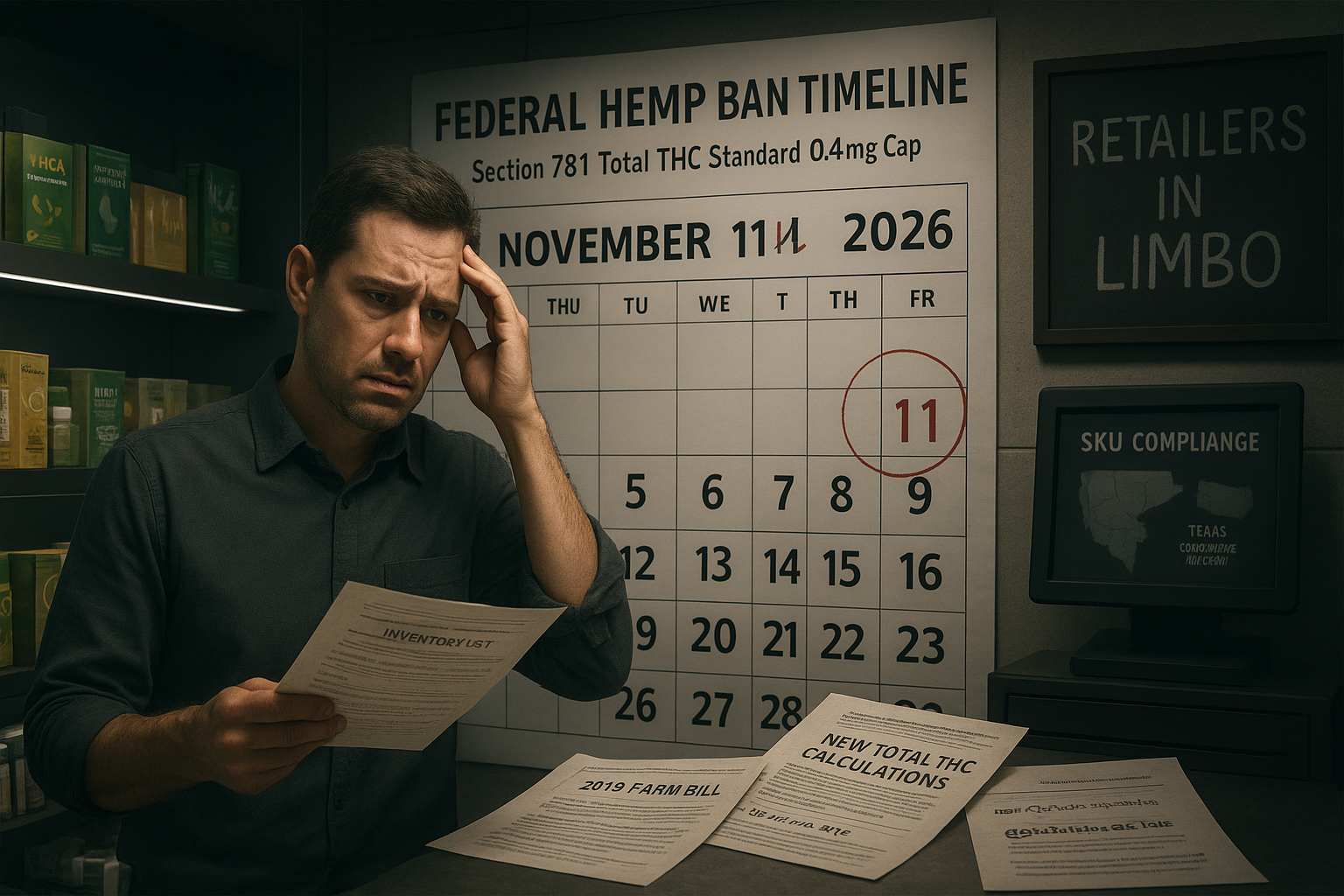
The federal law that redefines hemp is not a proposal sitting in committee somewhere. It is enacted, signed in November 2025, and it will change what counts as legal hemp nationwide once it takes effect. The only thing still moving is the calendar, and that matters enormously to any dispensary, smoke shop, or convenience retailer currently stocking THCA flower or delta-8 vapes.
Here is the mechanism operators need to understand. The 2018 Farm Bill set a single threshold - 0.3% delta-9 THC by dry weight - and an entire product category grew up around the fact that it measured nothing else. THCA flower, delta-8 vapes, HHC gummies: all built on that gap. Section 781 of the new appropriations law closes it by switching to a total-THC standard that folds THCA into the calculation and caps finished products at 0.4mg of total THC per container. For operators managing inventory across state lines, that shift touches everything from wholesale menus to how a cannabis pos virginia system tags SKUs for compliance reporting, since the products that were fine yesterday may not clear the new definition tomorrow. cannabis pos virginia
Retailers who have spent the past few years building POS categorization, batch tracking, and compliant packaging around delta-9-only testing now face a second overhaul, not a one-time fix. A Senate-passed stopgap would push most of these restrictions from November 12 to December 11, 2026, but that bill still needs House approval, and synthetic cannabinoids like delta-8 and HHC were carved out of the delay entirely - they still face the earlier date. That split matters for anyone doing inventory planning: naturally derived THCA products get an extra month on paper, converted cannabinoids do not.
What Actually Gets Hit, and What Survives
Three separate mechanisms decide what disappears from shelves. The total-THC threshold catches THCA flower, pre-rolls, and concentrates that test well above 0.4mg once raw THCA counts against the limit. The per-container cap catches delta-9 gummies and beverages at essentially any dosing retailers currently sell. And the synthetic-cannabinoid exclusion catches delta-8, delta-10, and HHC outright, regardless of potency, because those compounds are chemically converted from CBD rather than naturally occurring at scale in the plant. Industrial hemp grown for fiber and grain, along with CBD products that stay under the cap, are what remains standing.
The Vote That Didn't Settle Anything
The August 8 Senate vote tabling Senator Budd's amendment, followed by passage of the underlying continuing resolution, scrambled party lines rather than clarifying policy. Thirty-four Democrats and 26 Republicans voted together to preserve the delay; 21 Republicans and 11 Democrats wanted the original date kept. That is not a industry-versus-regulator split - it is a fight without a clean side, and it is still unresolved in the House. December 11 also happens to be when the broader funding extension expires, which sets up another legislative collision point rather than a clean resolution.
What This Means for Operators Right Now
Until an effective date actually arrives, the 2018 Farm Bill standard still governs what is federally legal. But state law is the more urgent compliance layer for most retailers today. California's AB 8 restricts THCA to licensed dispensaries, New Jersey bans intoxicating hemp retail outright, and a Texas court order has paused enforcement there - three very different postures, all layered on top of a federal floor that has not moved yet but is scheduled to.
- THCA flower, pre-rolls, vapes, and concentrates fail the new total-THC standard
- Delta-9 gummies and beverages at current dosing exceed the 0.4mg container cap
- Delta-8, HHC, and other synthesized cannabinoids are excluded regardless of potency
- Federal timing sets the baseline; state rules determine what's sellable locally on top of it
The practical move for operators is not waiting for certainty - there isn't going to be much before December. It's auditing product catalogs against total-THC math now, flagging synthetic-cannabinoid SKUs separately in POS systems, and treating every date in this rollout as provisional until Congress or a court says otherwise.