
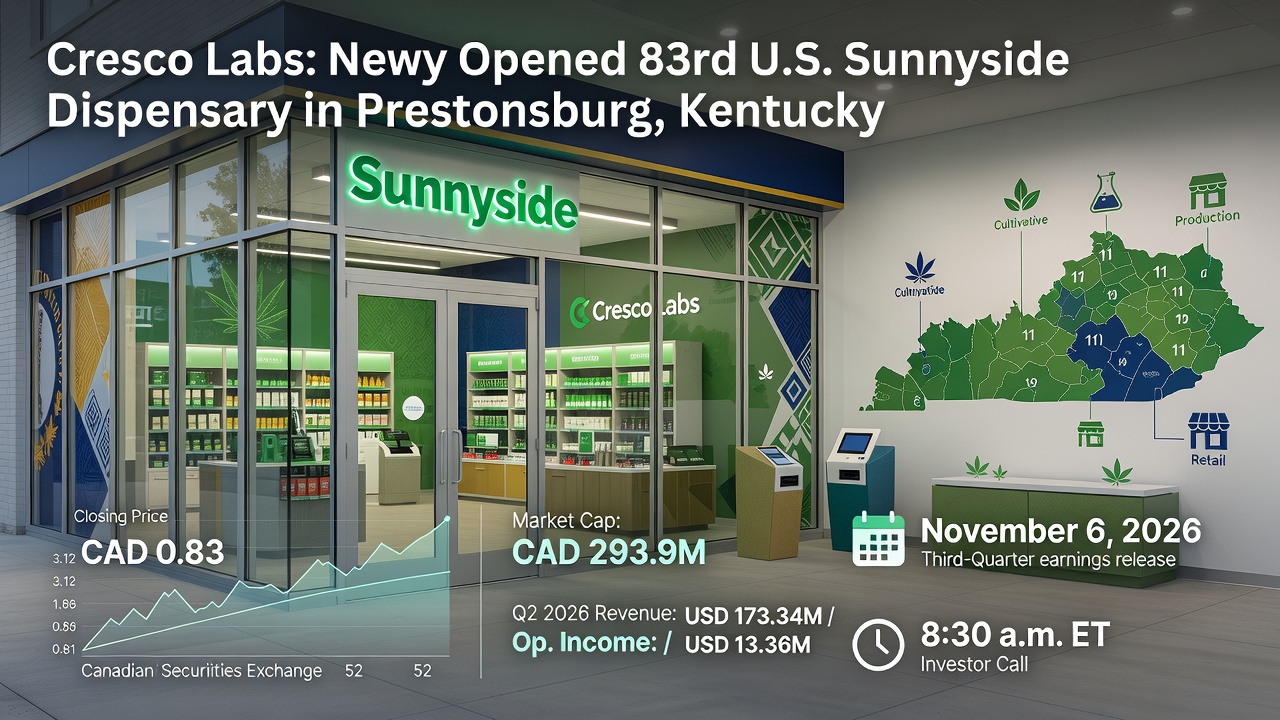
Cresco Labs has set November 6, 2026, as the date for its third-quarter results, giving the market a fixed point to measure the multistate operator's progress since midyear. The announcement, made October 15, lands alongside a more tangible development: the opening of the company's 83rd U.S. dispensary, a Sunnyside location in Prestonsburg, Kentucky, confirmed October 23 via Business Wire. Together, the two items frame a quiet but concrete stretch for a company whose shares continue to trade well below their 52-week high.
A Reporting Date With Real Stakes
Cresco will release results before the market opens on November 6, with an investor call set for 8:30 a.m. ET. That's a routine disclosure mechanic, sure, but the number that matters sits in the prior quarter: USD 173.34 million in revenue and USD 13.36 million in operating income for the period ended June 30, 2026. Those figures now serve as the baseline against which the September quarter will be judged. In practice, though, a single quarter doesn't tell you much about trend. What analysts and operators alike will watch is whether revenue held steady, slipped, or ticked up - and whether operating income, thin as it already was relative to top-line revenue, compressed further under the weight of excise tax, wholesale pricing pressure, or SG&A tied to retail expansion.
Multistate cannabis operators report under an accounting structure still shaped by Section 280E, the federal tax provision that disallows standard business deductions for companies trafficking in a federally controlled substance. That single rule continues to distort margins across the sector, making operating income a more telling figure than net income for comparing quarter to quarter.
Store Count As An Operating Signal
The Prestonsburg opening pushed Cresco's U.S. dispensary footprint to 83 locations and, notably, extended Sunnyside's presence into all 11 regions of Kentucky's medical cannabis program. That's not a small operational detail. Entering every region of a state program means the company has cleared local zoning, built out compliant packaging and point-of-sale infrastructure, and satisfied state-level licensing requirements across a geographically fragmented market - Kentucky's medical program is still young, and buildout logistics there differ meaningfully from mature adult-use states.
For a vertically integrated operator - one that handles cultivation, production, branded distribution, and retail under one structure - each new store adds inventory management complexity: seed-to-sale tracking through METRC, batch-level COA documentation, and staff training on age verification and purchase limits. Retail expansion looks good on an investor slide. It also adds fixed costs before the revenue catches up, which is exactly why the November report matters as a gauge of whether store growth is translating into top-line gains or simply adding overhead.
What The Market Is Pricing In
Cresco shares closed at CAD 0.83 on the Canadian Securities Exchange on October 23, against a 52-week range of CAD 0.81 to CAD 3.12. Market capitalization stood at CAD 293.9 million, with trading volume of just 25,833 shares that day - thin, by most standards. On Lang & Schwarz, the German over-the-counter venue, the stock traded at EUR 0.55 on October 24. The spread between the stock's 52-week high and its current level suggests the market has already priced in a fair amount of caution about the sector's growth trajectory, well before the September-quarter numbers land.
Two dates now sit on the calendar: the annual and special shareholder meeting on October 30, followed by third-quarter results on November 6. For investors, suppliers, and landlords with exposure to Cresco's retail footprint, that sequence offers a short, concrete checklist - governance first, then operating performance. Whether the Kentucky expansion shows up as incremental revenue, and whether operating income holds near its June-quarter level, will tell a more useful story than the store count alone.