
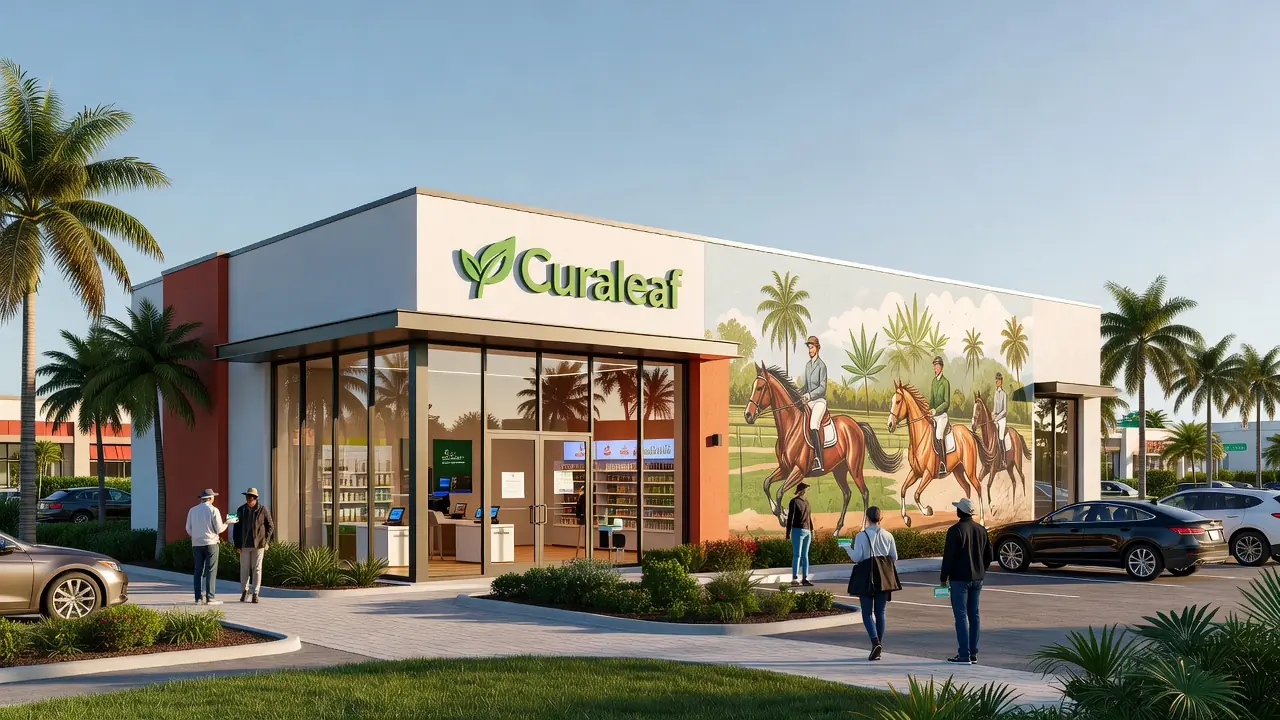
Curaleaf Holdings has opened its 79th Florida dispensary, this one in Wellington, bringing the multi-state operator's nationwide store count to 189. The location, on State Road 7 near The Mall at Wellington Green, puts the company deeper into Palm Beach County's medical cannabis market at a moment when Florida continues to be one of the most closely watched state programs in the country.
Why Florida Keeps Drawing Store Openings
Florida's medical cannabis program operates under a vertically integrated license structure, meaning companies like Curaleaf must cultivate, process, and retail their own products rather than buying wholesale from third parties. That model rewards scale. More dispensaries mean more consistent throughput for cultivation facilities and processing lines, which is part of why operators keep adding doors even in a market that's already dense with competition. For a public company reporting to shareholders on both the TSX and OTCQX, store count is also a visible, easy-to-track growth metric - arguably more so than same-store sales, which get less attention in press materials.
The Wellington location's geography is deliberate. Sitting near the Forest Hill Boulevard corridor puts the store within reach of Royal Palm Beach, Greenacres, and Lake Worth, not just Wellington proper. In retail cannabis, as in any brick-and-mortar business, drive-time radius matters more than city limits. Operators mapping new locations are typically solving for patient density within a 15 to 20 minute drive, not municipal boundaries.
Local Identity as a Retail Differentiator
The custom mural referencing Wellington's equestrian heritage - the village sits adjacent to a 9,000-acre Equestrian Preserve and hosts the Winter Equestrian Festival each year - points to a broader trend in dispensary design. As the number of storefronts in a given county climbs toward 79, as it has here, differentiation stops being about product alone. Build-out, signage, and community-specific detailing become part of how an operator competes for repeat patient visits, especially since Florida's advertising rules for cannabis businesses remain more restrictive than those governing ordinary retail. A storefront that signals local roots does some of the marketing work that billboards and broadcast ads legally cannot.
What Multi-Store Growth Means for Compliance and Operations
Scaling to 189 stores nationwide is not simply a real estate exercise. Each new Florida dispensary adds another node to the company's seed-to-sale tracking obligations, another set of POS terminals that must stay synced with state reporting systems, and another location requiring its own compliance logs for age verification, qualifying patient ID checks, and product batch traceability back to lab testing results. Florida requires a valid medical card for purchase, and Curaleaf's promotional structure for the Wellington opening - including an offer limited to patients with qualifying cards - reflects that regulatory baseline rather than a discretionary business choice.
For an operator this size, inventory management across nearly 200 doors also means more exposure to the kind of shrinkage, batch mislabeling, or compliant-packaging errors that can trigger state inspection findings. None of that is unique to Curaleaf; it's the operational reality facing any vertically integrated MSO trying to keep pace with store growth without letting compliance infrastructure lag behind retail expansion. The company's continued investment in Florida - a state with one of the larger registered medical patient populations in the country - suggests confidence that demand growth will keep outpacing the administrative burden that comes with it. Whether that holds as the store count climbs further is the question worth watching.