
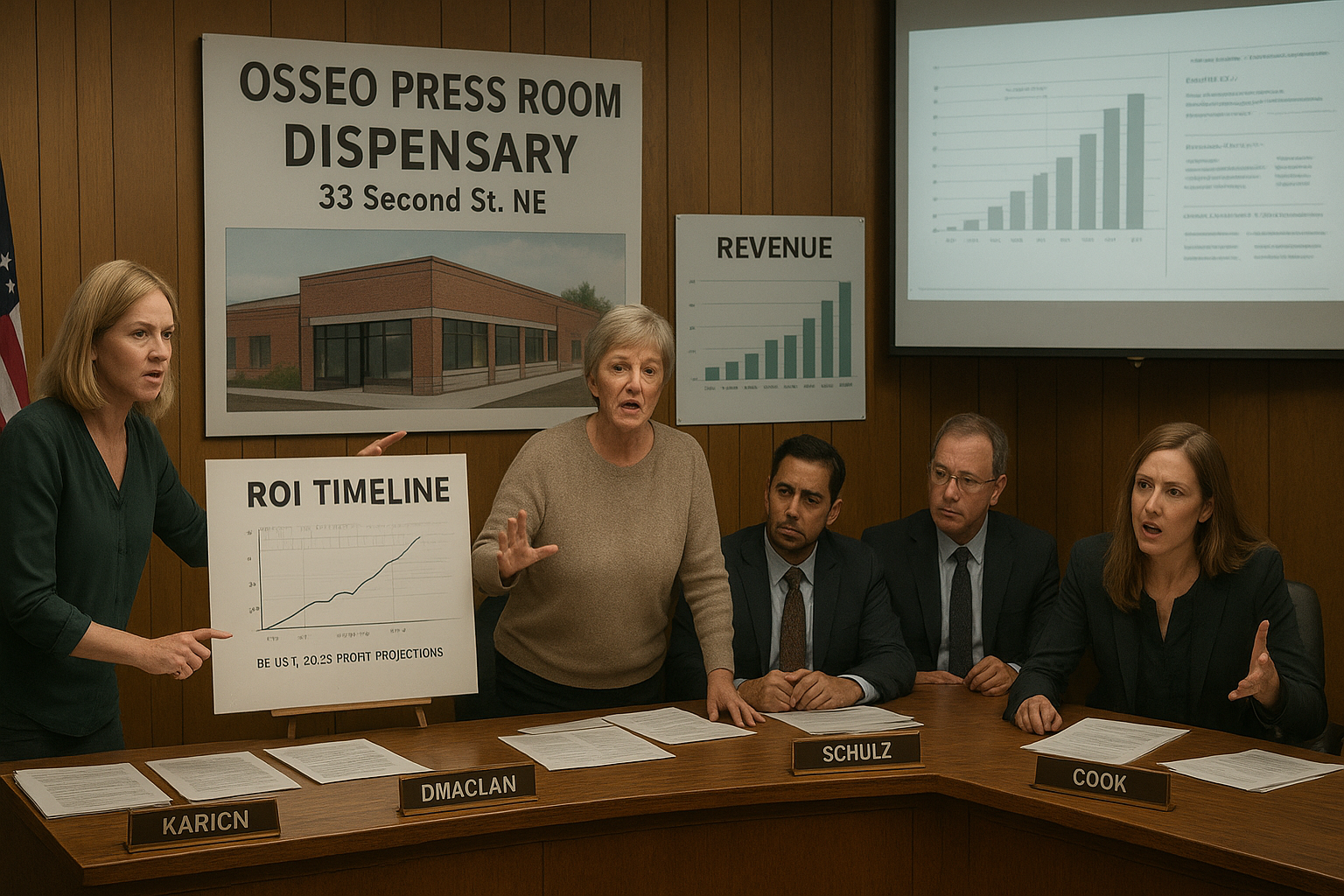
A municipal cannabis dispensary project in Osseo, Minnesota hit a significant wall on June 22, when the City Council declined to act on a tax abatement bonding resolution after residents raised pointed objections about financial risk, transparency, and the pace of the project. The proposed facility - branded as the Osseo Press Room Dispensary and planned for 33 Second St. NE - would have been financed through up to $4 million in general obligation tax abatement bonds, with cannabis revenues earmarked to service the debt. The council voted to take no action, leaving the bond sale date and project timeline in question.
What makes this situation instructive for cannabis retail professionals beyond Osseo is the financing mechanism itself. General obligation bonds are not cannabis-specific instruments; they are municipal debt tools most often used for infrastructure. Using them to fund a retail dispensary buildout puts taxpayers explicitly on the hook if revenues fall short - a structural risk that is rarely discussed openly in cannabis license applications or feasibility studies. Financial advisors elsewhere have flagged similar concerns with municipally operated dispensaries, noting that unlike private operators who absorb losses directly, cities must cover debt service gaps through tax levies. Operators evaluating retail technology platforms - whether dispensary software in Michigan or comparable solutions in Minnesota - often build revenue models that assume a maturing market, stable wholesale pricing, and consistent consumer traffic, but those assumptions deserve scrutiny in any jurisdiction where the adult-use retail environment is still settling.
Rebecca Kurtz of Ehlers' Public Finance Advisors was candid about the structure's exposure. The bonds would be general obligation instruments, meaning that any revenue shortfall from cannabis sales would trigger a property tax levy to cover debt service. With a maximum term of 20 years and a bond ceiling of $4 million, the annual debt service ceiling was set at $350,000 - a figure that happens to match Voyageur Cannabis's projected annual cash flow from the dispensary. That's a razor-thin margin. In regulated cannabis retail, revenue projections for new dispensaries are built on assumptions about foot traffic, average transaction size, competitive density, and compliance overhead. Any one of those variables can shift materially, especially in a state where the licensed market is relatively new and wholesale supply chains are still establishing pricing floors.
Residents Identify the Core Risk Most Feasibility Studies Obscure
The public forum revealed something worth sitting with: residents without formal financial training identified the structural problem quickly. Carrie Kehn calculated that based on 2024 profit projections in the council packet, the dispensary would require more than a decade to show a positive return on investment. She also noted that if the business underperforms or fails, the debt does not disappear - repayment falls to property tax. That's not a misreading of the proposal; that's precisely how general obligation bonds work.
Margaret Dunbar asked whether the revenue figures were grounded in the current cannabis market - a fair challenge. Cannabis retail economics in the Midwest are not static. Wholesale pricing has shifted in states where production capacity outpaced retail demand, compressing margins at the store level. Feasibility projections built even 18 months ago may not reflect today's competitive or pricing environment. Dunbar's question - "Are these even the right numbers in the rapidly changing cannabis landscape?" - is the kind of due-diligence question that a private investor or institutional lender would ask before a credit committee approved a term sheet.
Faith Newman suggested the council pause and reassess rather than proceed under momentum. Councilmember Nick Torres agreed, saying the data wasn't adding up for him. Councilmember Schulz introduced another variable: a private operator had expressed interest in taking over the dispensary side of the building if the city chose not to proceed. That's a meaningful data point. A private tenant eliminates the city's operational liability, removes the bond financing need, and potentially still generates lease revenue from a property the city already controls.
Municipal Cannabis Operations Carry Risks Private Operators Spread Differently
Osseo isn't the only municipality in the country that has explored running its own cannabis retail operation. A handful of jurisdictions have pursued municipal dispensary models as a way to capture revenue without ceding it to private license holders. The theory is sound enough on paper. In practice, though, municipal operations face structural disadvantages that private operators manage through operational flexibility - the ability to adjust staffing, renegotiate vendor contracts, pivot SKU strategy, or close underperforming locations. A city cannot pivot as easily, and its debt obligations follow a fixed schedule regardless of sales performance.
There's also the compliance dimension. A licensed cannabis dispensary - regardless of whether it's privately or municipally operated - carries the same regulatory obligations: seed-to-sale tracking, state-mandated point-of-sale reporting, compliant packaging verification, age-gating at the transaction level, and inventory reconciliation with the state's tracking system. Those are operational costs that don't scale down if revenue disappoints. For a small city operating a single retail location without the overhead absorption of a multi-site operator, compliance costs represent a higher percentage of revenue than they would for a regional chain.
What the Council's Pause Actually Signals
The decision to take no action on the tax abatement resolution was not a vote against the dispensary - it was a vote for more time. That distinction matters. The council's posture, as reflected in comments from Cook, Torres, and Schulz, was not hostility to cannabis retail but discomfort with committing to general obligation debt on data that hadn't been sufficiently stress-tested. Cook said plainly that he needed to go back over his notes and take a breath. Torres said the numbers weren't adding up. Those are reasonable positions given the financial structure on the table.
The Schulz disclosure about a potential private operator deserves follow-through. If a qualified private licensee is willing to operate the dispensary - or lease the space and bear the operational and compliance risk - the city may be able to capture the same economic development objective without assuming the debt. That would also eliminate the general obligation bond exposure that alarmed residents. The building has already been gutted and is moving toward a two-tenant configuration. Whether the dispensary tenant is municipal or private, the real estate investment has already been made.
For cannabis operators and investors watching municipal licensing strategies develop across the country, Osseo's June 22 meeting is a useful case study in what happens when financing structures, public communication, and community trust aren't built in parallel with the operational plan. The dispensary may still open. The question is who runs it, on whose balance sheet, and with what exposure for the people who live there.