
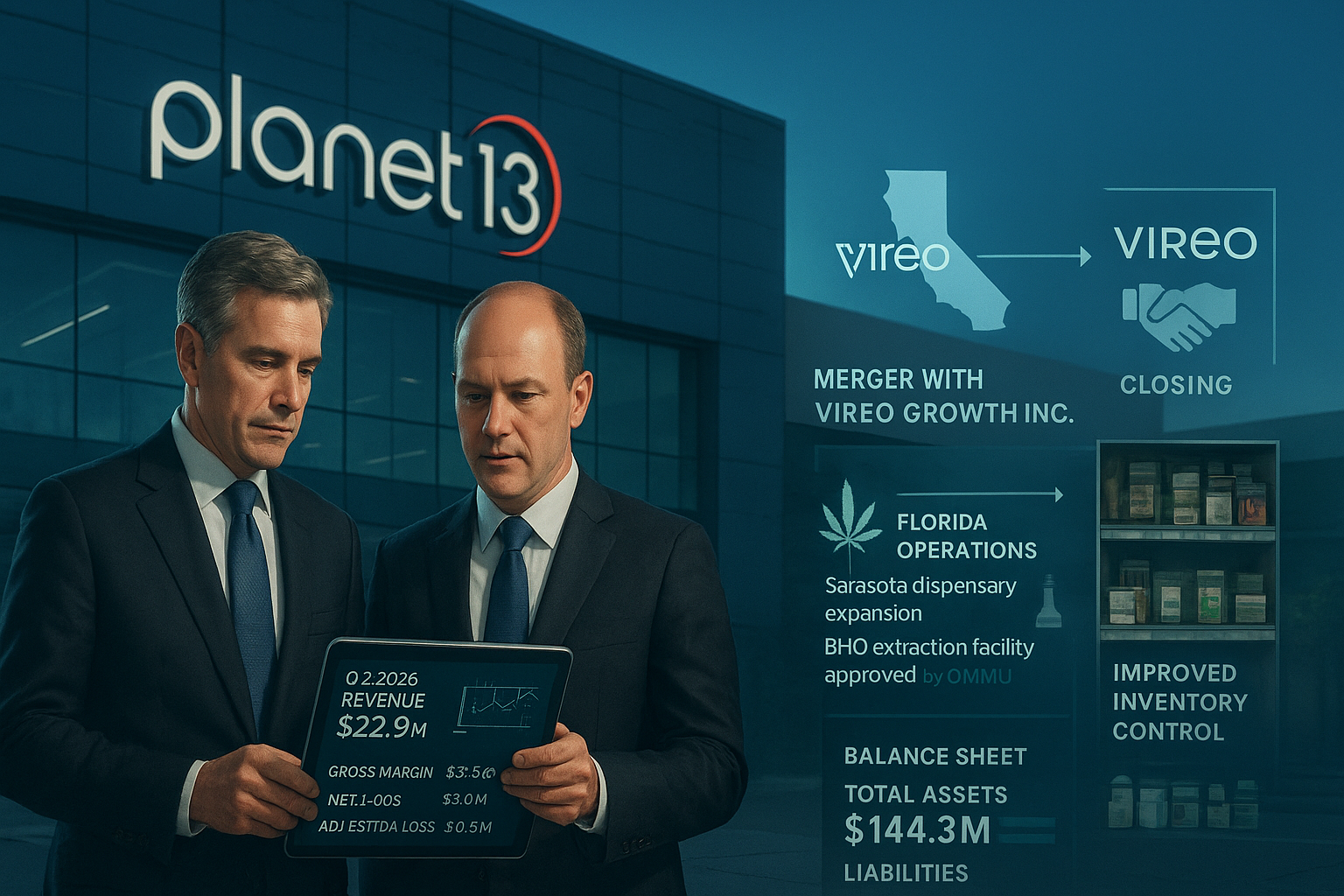
Planet 13 Holdings reported second-quarter 2026 revenue of $22.9 million, down 14.9% from a year earlier, as the multi-state operator continued unwinding its California operations and absorbed ongoing price compression in Nevada and Florida. The results, disclosed August 12, arrive as the company works toward closing its previously announced merger with Vireo Growth Inc., a deal that will reshape how investors should read every line item in this filing.
Margin Gains Tell a More Complicated Story Than the Top Line
Revenue fell, but gross margin actually improved to 53.9% from 43.4% a year ago. That's not a small move in a business where wholesale pricing keeps grinding lower across nearly every mature adult-use market. The lift came from exiting California retail and wholesale entirely, company-wide procurement discipline, and a $1.0 million release of an inventory reserve tied to Florida distillate. Strip out that reserve adjustment, and margin still lands at 49.5% - a real improvement, not an accounting mirage. For operators watching their own cost of goods sold creep upward, the lesson here is straightforward: exiting a bleeding market can do more for the P&L than chasing incremental sales growth in it. Total expenses dropped 17.7% to $15.2 million, and net loss narrowed to $5.6 million from $13.3 million. Adjusted EBITDA loss shrank to $0.5 million from $2.4 million, a meaningful gap-closer even if profitability remains out of reach for now.
Florida's Rebound and the Limits of a Single-State Fix
Florida revenue rose 17.1% quarter over quarter, according to Co-CEO Larry Scheffler, and the company secured OMMU approval in May for a BHO extraction facility, with a Sarasota store expansion announced in July. Extraction capacity matters here - it gives Planet 13 more control over concentrate supply and product batches feeding its own dispensary shelves rather than relying solely on outside processors, which can tighten margins when done right. Still, one state's sequential improvement doesn't offset the structural pressure showing up in the year-over-year numbers. Price compression in mature medical and adult-use markets isn't a temporary dip; it's the market maturing, more cultivators and processors chasing the same shelf space, and dispensaries competing on price because differentiation is hard when COAs and compliant packaging look similar across brands.
Why the Merger Framing Matters More Than the Quarter
Co-CEO Bob Groesbeck was candid about the strategic logic: the market increasingly rewards scale, purchasing power, distribution breadth, and balance sheet strength to absorb continued price compression. That's a fair reading of where multi-state cannabis operators sit right now. Smaller vertically-integrated companies face a tough math problem - cultivation, extraction, and retail all require capital, and 280E tax treatment keeps eating into cash flow regardless of operational improvement. Combining with Vireo Growth is meant to address that scale problem directly. Notably, Planet 13 skipped its usual conference call this quarter specifically because of the pending merger, a signal that management wants attention focused on deal execution rather than quarterly noise. For shareholders, employees, and the patients and customers the company serves across Nevada, Illinois, and Florida, the operational story now runs parallel to a corporate transaction story - and the two are increasingly hard to separate.
What Operators and Investors Should Watch Next
- Whether Florida's sequential growth holds as extraction capacity comes online and inventory reserves normalize
- How the Vireo merger timeline affects capital allocation and store expansion plans in the interim
- Continued price compression trends in Nevada, historically a higher-margin market for Planet 13
- Balance sheet trajectory, with total liabilities rising to $105.5 million against total assets of $144.3 million as of quarter-end
None of this changes the underlying consumer-safety framework that governs how these products reach shelves - lab testing, compliant packaging, and age-restricted retail access remain non-negotiable regardless of corporate structure. What changes, if the merger closes, is who's accountable for maintaining those standards at scale.