
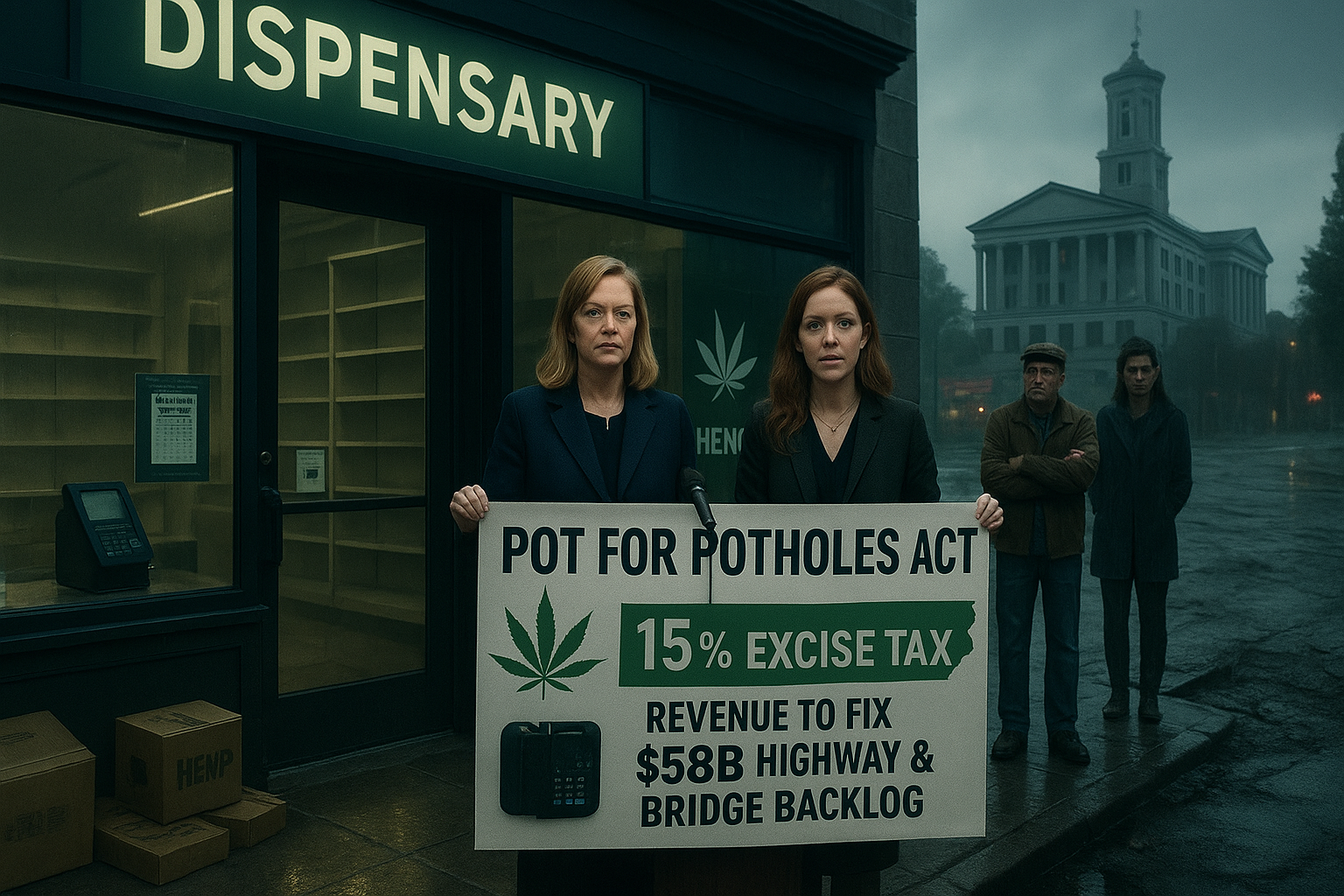
Tennessee's ban on THCa products took effect this week, pulling regulated hemp inventory off dispensary shelves statewide and threatening the survival of small businesses that built their operations around a legal market the state itself created seven years ago. Into that gap, two Nashville Democrats - Sen. Heidi Campbell and Rep. Aftyn Behn - are pushing the "Pot for Potholes Act," a marijuana legalization bill that would direct a 15% excise tax on cannabis sales toward the state's estimated $58 billion backlog of highway and bridge projects. The bill faces long odds in a Republican-controlled legislature, but the timing is pointed.
For dispensary operators and hemp retailers in Tennessee, the immediate compliance pressure is acute. Stores that stocked THCa products - which under state regulation contained less than 0.3% delta-9 THC - must now clear that inventory entirely. THCa converts to THC when combusted, which is what drew legislative scrutiny, but licensed retailers had been moving compliant product with lab-tested certificates of analysis, tracked through state-required systems. If you want to understand what a compliant, tech-enabled retail operation looks like in a market where regulatory conditions shift fast, see how it works - because operators without robust point-of-sale and inventory management infrastructure are the ones most exposed when a ban lands overnight. The companies that survive regulatory whiplash tend to be those with clean SKU management, real-time compliance logs, and the ability to pull product batches without operational chaos.
Campbell put it plainly: Tennessee didn't make cannabis disappear - it pushed consumers toward unlicensed sources or neighboring states with adult-use programs, removing both the tax revenue and the consumer safety infrastructure that licensed retail provides. That's not a small concern. In a licensed market, products move with COAs, age-verification at point of sale, and packaging that meets state standards. In an illicit or gray market, none of that applies. The hemp businesses that followed Tennessee's rules, invested in compliance, and built retail operations under a framework the state endorsed are now being told the framework no longer exists.
What the "Pot for Potholes Act" Actually Proposes
The Campbell-Behn bill would establish adult-use cannabis for residents 21 and older, require state licensing for cultivation, testing, and retail, and impose a 15% tax on sales. Revenue would flow toward infrastructure - specifically the state's substantial highway and bridge maintenance backlog. The infrastructure angle is deliberate. It's a rhetorical and political frame designed to find common ground in a legislature where cultural opposition to cannabis legalization runs deep, connecting an unpopular product to a universally relatable problem: bad roads.
In practice, though, the mechanics of standing up a regulated cannabis market are considerably more involved than a tax rate and a license requirement. States that have launched adult-use programs have had to build out seed-to-sale tracking systems, establish testing laboratory certification frameworks, write compliant packaging and labeling rules, create social equity provisions, and resolve banking access problems - since cannabis businesses remain largely shut out of traditional financial services under federal law, leaving operators dependent on cash or specialized cashless payment solutions. The 280E tax provision, which disallows most standard business deductions for cannabis businesses under federal law, adds another layer of financial pressure for any licensed operator. Tennessee would face all of that if legalization advanced.
The Federal Backdrop Matters Here
Campbell and Behn are not operating in a vacuum. The federal rescheduling process - which would reclassify marijuana differently from Schedule I when contained in FDA-approved products or permitted by state law - is still working through regulatory channels. Recreational cannabis remains Schedule I federally, but 24 states have enacted adult-use programs, and the political math is shifting. Immediately after the federal government began loosening restrictions, a bipartisan pair of Tennessee lawmakers - Democratic Sen. London Lamar and Republican Rep. Jeremy Faison - called for state law reform. That's a data point worth noting: it's not purely a partisan issue at the state level, even if the legislature's leadership hasn't moved.
Lt. Gov. Randy McNally, a pharmacist who is departing the legislature this year, has been explicit that he sees no path forward for rescheduling marijuana at the state level. His departure removes one significant institutional obstacle. Whether that changes the political arithmetic meaningfully in 2027 - when Campbell and Behn plan to reintroduce the bill - remains to be seen.
The Business Stakes for Tennessee Operators
The most immediate consequence of this week's ban is economic and operational, not legislative. Businesses that built their retail model around regulated hemp products - compliant inventory, licensed storefronts, tested product lines - are now absorbing a sudden revenue loss. The state had projected roughly $180 million in annual revenue from these products. That number is now zero from a licensed-retail standpoint, though consumer demand doesn't evaporate with a legislative ban.
What's striking here is the sequence: Tennessee bolstered its hemp market in 2018, enabling cannabis-adjacent retail to expand statewide. Businesses invested. Operators hired. Then, seven years later, the same regulatory environment reversed course without a transition mechanism for the businesses caught in between. For operators in other states watching this - particularly those in markets where THCa or hemp-derived cannabinoid products occupy a legal gray zone - Tennessee is a case study in regulatory risk that no amount of compliance infrastructure can fully insulate against. You can run a clean operation, maintain every required log, pass every lab test, and still face shutdown if the political will shifts fast enough.
The "Pot for Potholes Act" may not pass in 2027 either. But Tennessee's hemp ban has handed its sponsors an unusually concrete argument: a regulated market was just dismantled, and the revenue and consumer safety it provided went with it. That argument tends to get more compelling the longer the alternative plays out.