
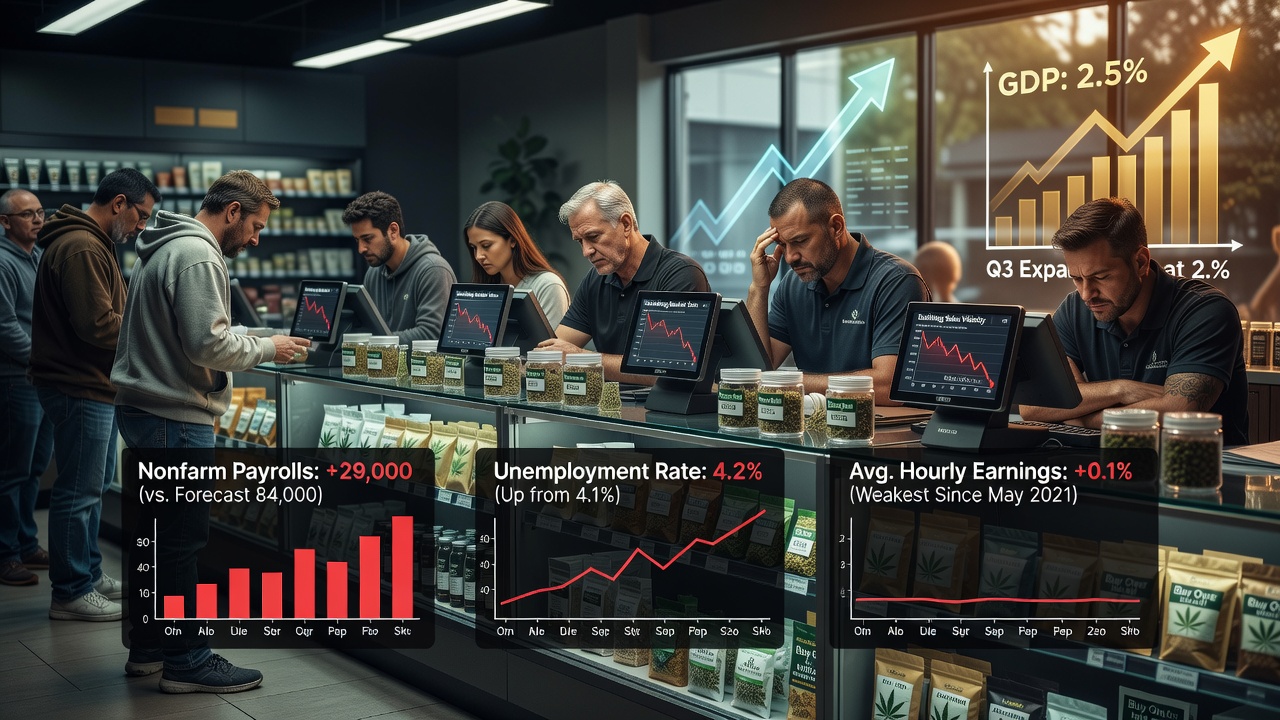
The September jobs report landed well short of expectations, and that matters for cannabis retail even though the Bureau of Labor Statistics never mentions dispensaries. Nonfarm payrolls rose just 29,000 against forecasts of 84,000, while unemployment ticked up to 4.2%. For operators running thin-margin storefronts in a cash-heavy, federally unbanked industry, a softening labor market and a more dovish Federal Reserve outlook are worth watching closely.
Why a Soft Labor Market Touches Dispensary Economics
Cannabis retail is discretionary retail. When wage growth slows - and average hourly earnings rose just 0.1% in September, the weakest 12-month pace since May 2021 - household budgets tighten first around non-essential purchases. Dispensary operators already track this instinctively: basket sizes shrink before unit counts do, and budroom inventory that once moved on brand loyalty starts moving on price. A labor market showing "low-hire, low-fire" behavior, as the data suggests, doesn't necessarily crater foot traffic, but it does tend to compress average ticket size and push consumers toward value SKUs and promotional wholesale pricing tiers.
Interest Rates, 280E, and the Capital Squeeze
Here's the part that actually hits balance sheets directly. Markets now assign heavy odds to the Federal Reserve holding rates steady at its October meeting, largely because of this report. That's relevant for an industry that already borrows at a premium. Cannabis operators, blocked from standard banking relationships and still burdened by Section 280E's disallowance of ordinary business deductions, pay more for capital than almost any other licensed retail category. Multi-state operators carrying real estate debt, build-out loans, or working-capital lines tied to variable rates benefit when the Fed holds rather than hikes. A pause doesn't fix the structural cost of capital cannabis businesses face, but it does slow further deterioration - and for operators managing tax bills that already run well above conventional retailers, that's not a small thing.
What Operators Should Actually Watch
The thing is, no single jobs report changes licensing rules, lab testing requirements, or compliant packaging standards. Regulatory and operational fundamentals stay the same. But macro conditions shape consumer behavior and lending terms, and dispensary owners should treat this report as a planning signal rather than noise.
- Consumer spending patterns: softer wage growth may push demand toward lower-priced SKUs and away from premium brands.
- Financing costs: a Fed pause eases pressure on variable-rate debt tied to store build-outs or inventory financing.
- Labor costs in-store: wage disinflation nationally could ease hiring pressure for budtenders and compliance staff, though local minimum wage laws still govern store-level pay.
- Seed-to-sale and POS data: operators tracking SKU-level sales through METRC-integrated point-of-sale systems should watch for early signs of basket-size compression.
A Broader Economy That Doesn't Fit One Narrative
What's striking here is the contradiction baked into the data itself. GDP growth has stayed strong - 2.5% and 2.2% in the first two quarters, with the Atlanta Fed tracking third-quarter growth near 3.7% - even as hiring stalls. That mismatch matters for cannabis retail because the industry sits at an odd intersection: treated as a luxury or discretionary category by consumer spending patterns, yet taxed and regulated like neither alcohol nor pharmaceuticals. Operators planning fourth-quarter inventory, staffing, or expansion decisions should factor in a labor market that is cooling, inflation that remains above target, and a Fed more inclined to hold steady than tighten further. None of that changes compliance obligations. It does change the financial environment those obligations have to be met inside.