
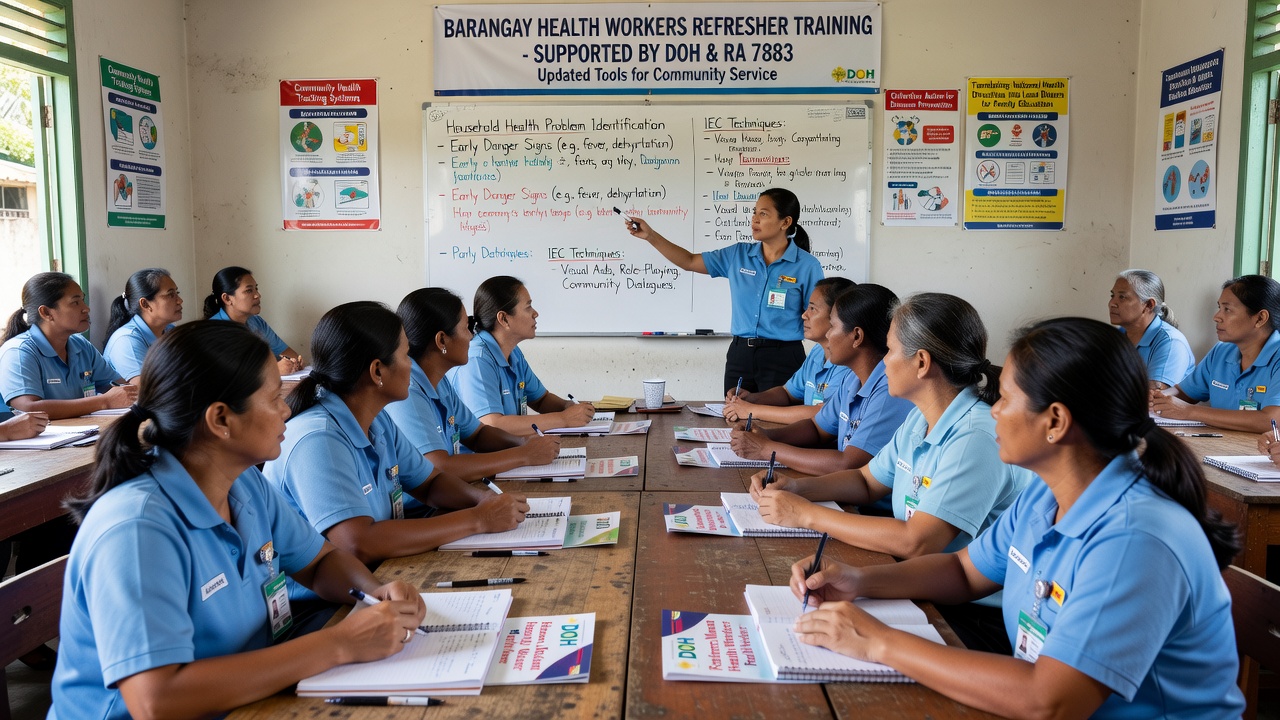
A local government unit convened its Barangay Health Workers (BHWs) for a refresher activity grounded in Republic Act 7883, the law that obligates the Department of Health to support the continuing development of these frontline volunteers. The session centered on updated program guidelines and a new Reference Manual meant to standardize what BHWs know and what they can do in the field. That distinction matters more than it sounds.
Why the Legal Mandate Exists
RA 7883 did not appear out of nowhere. It responded to a long-standing gap: BHWs carry enormous responsibility in the Philippine health system, yet for years many operated without formal, consistent access to training, resources, or career support. The law directs the DOH to close that gap by ensuring access to opportunities for personal and professional growth. In practice, though, that mandate only becomes real at the barangay level, through activities like this one, where updated guidance actually reaches the people doing the work.
What the Training Actually Covers
The activity had four concrete aims, and each one addresses a different pressure point in community health delivery.
- Aligning BHWs with current DOH program guidelines and the department's broader direction for the health system
- Introducing the new Reference Manual so expected knowledge and skills are consistent across barangays
- Strengthening BHWs' ability to help households identify health problems early, before they escalate
- Reinforcing information, education, and communication (IEC) work, including direct household teaching
That last point deserves attention. Household teaching is not a side task; it is often the only health literacy intervention many families receive between clinic visits. A BHW who can explain a danger sign clearly, in the household's own terms, functions as an early warning system the formal health system cannot replicate on its own.
The Unseen Labor Behind Public Health Numbers
BHWs rarely appear in headlines, yet they do the quiet work that keeps community health programs functional: tracking households, flagging emerging problems, organizing neighbors toward collective action, and translating DOH directives into language people actually understand. What's striking here is how much of the public health system depends on this layer of volunteer labor, work that is chronically under-resourced relative to its actual impact.
Updating their knowledge base is not a bureaucratic formality. Health guidelines shift, new programs roll out, and without a mechanism to keep BHWs current, the information reaching households grows stale or inconsistent. A unified Reference Manual addresses that risk directly, giving every BHW in the barangay the same baseline regardless of when they were trained or by whom.
Local Government Support as a Determining Factor
None of this happens without sustained backing from local officials. The activity drew explicit recognition of the Municipal Mayor, the Vice Mayor, and the Sangguniang Bayan for their continued support - and that recognition is not mere courtesy. BHW programs live or die on local government funding, scheduling, and political will. National mandates like RA 7883 set the floor, but it is the municipal level that determines whether BHWs actually receive updated manuals, structured sessions, and the institutional respect the law intends for them.
To put it plainly: a law on paper and a functioning BHW corps are two different things. The distance between them is closed, barangay by barangay, through exactly this kind of recurring investment in training and recognition.