
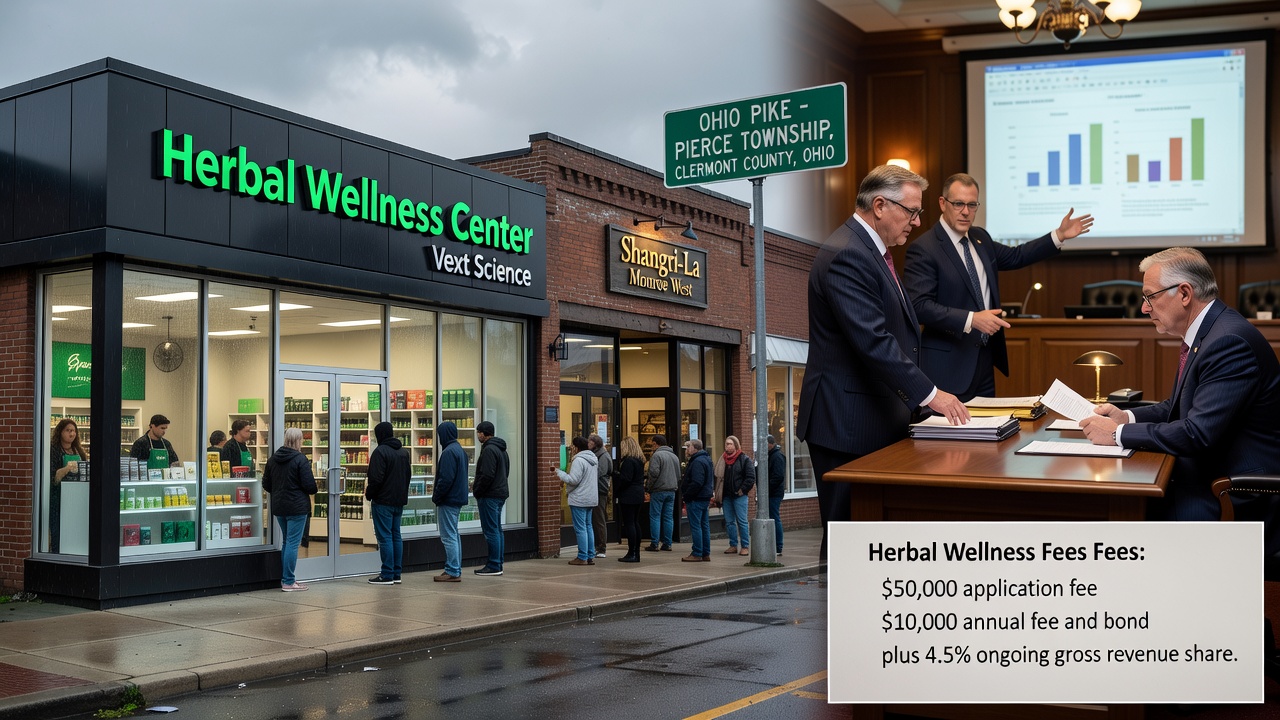
A zoning dispute in a small Clermont County township has turned into a test case for how far local governments can go in extracting payments from cannabis retailers before granting them permission to open. Vext Science, which operates Herbal Wellness Center dispensaries in Ohio, says Pierce Township demanded a package of fees and ongoing revenue-sharing terms that amounted to an illegal condition on licensure - and that the practice is spreading across townships in the southwest part of the state.
What the township asked for, and why it matters
According to Vext, Pierce Township wanted a $50,000 application fee, a $10,000 annual fee and bond, and 4.5% of gross dispensary revenue - paid indefinitely, as a condition of operating. That's not a one-time cost of doing business. It's a recurring tax-like obligation layered on top of what Ohio already collects through its 10% excise tax on adult-use cannabis sales, a portion of which state law already routes back to host townships and cities. Vext's argument is straightforward: Ohio's cannabis statute bars local governments from singling out a specific business type for fees that other retailers in the same township don't pay. If that reading holds, "community benefit agreements" structured this way could be legally vulnerable statewide, not just in Pierce Township.
Zoning leverage versus statutory limits
Local zoning authority over cannabis retail is real - townships can set hours, buffer zones, signage rules, and site plans. What they generally can't do, under most state cannabis frameworks, is use that zoning leverage as a backdoor tax. Vext's first lawsuit challenged the Pierce Township Board of Zoning Appeals' denial of its permit; a county judge called the board's decision "illegal, arbitrary, capricious, unreasonable, and unsupported" by the evidence, and the Ohio 12th District Court of Appeals agreed. That ruling forced a partial settlement and, eventually, a permit. The second lawsuit - seeking $2.5 million in damages, legal fees, and lost profit - is still pending, and it's the one that will actually decide whether townships can keep writing revenue-share clauses into operating agreements.
Why some operators sign anyway
Here's the catch: not every dispensary fights these terms. A competing retailer near the same stretch of Ohio Pike, Shangri-La Monroe West, signed essentially the same agreement - $50,000 application fee, $10,000 annual fee and bond, 4.5% of gross sales - and opened this summer without litigation. Township trustee Allen Freeman points to that as proof the terms are reasonable and that Vext simply chose confrontation over cooperation. Vext's counsel sees it differently: in a market carved into dozens of small townships, many of which imposed moratoriums early on, scarcity gives local officials outsized bargaining power over where a license can actually be used. An operator sitting on a signed lease, build-out drawings, and a tight timeline has strong incentive to sign whatever is put in front of them rather than delay opening for a year while a court sorts out the legality.
What this means for operators and landlords elsewhere
For multi-state operators and single-license dispensary groups, the lesson is procedural as much as legal. Site selection in a fragmented regulatory map - small townships, inconsistent moratoriums, locally negotiated agreements - carries real timeline risk that doesn't show up in a standard real estate pro forma. A lease signed on the assumption of a routine permit can sit dormant for years if a township treats zoning approval as a negotiation rather than a ministerial process. Landlords, lenders, and compliance teams evaluating new Ohio locations should factor in the possibility of extended entitlement delays, and operators should get clarity in writing - before signing a lease - on what fees, bonds, or revenue-share terms a township intends to impose. Whatever the outcome of the pending damages claim, the underlying question will keep surfacing as more Ohio townships decide how to treat adult-use retail within their borders.