
With Kansas's August 4 gubernatorial primary closing in, cannabis legalization has emerged as a fault line separating the state's political parties - and, increasingly, Republican candidates from their own voters. Every Democratic candidate in the race supports legalizing at least medical cannabis. No Republican candidate does. That disconnect matters well beyond campaign positioning: Kansas remains one of a dwindling number of states where cannabis is illegal in any form, while the licensed retail market continues to expand in neighboring Missouri and Oklahoma.
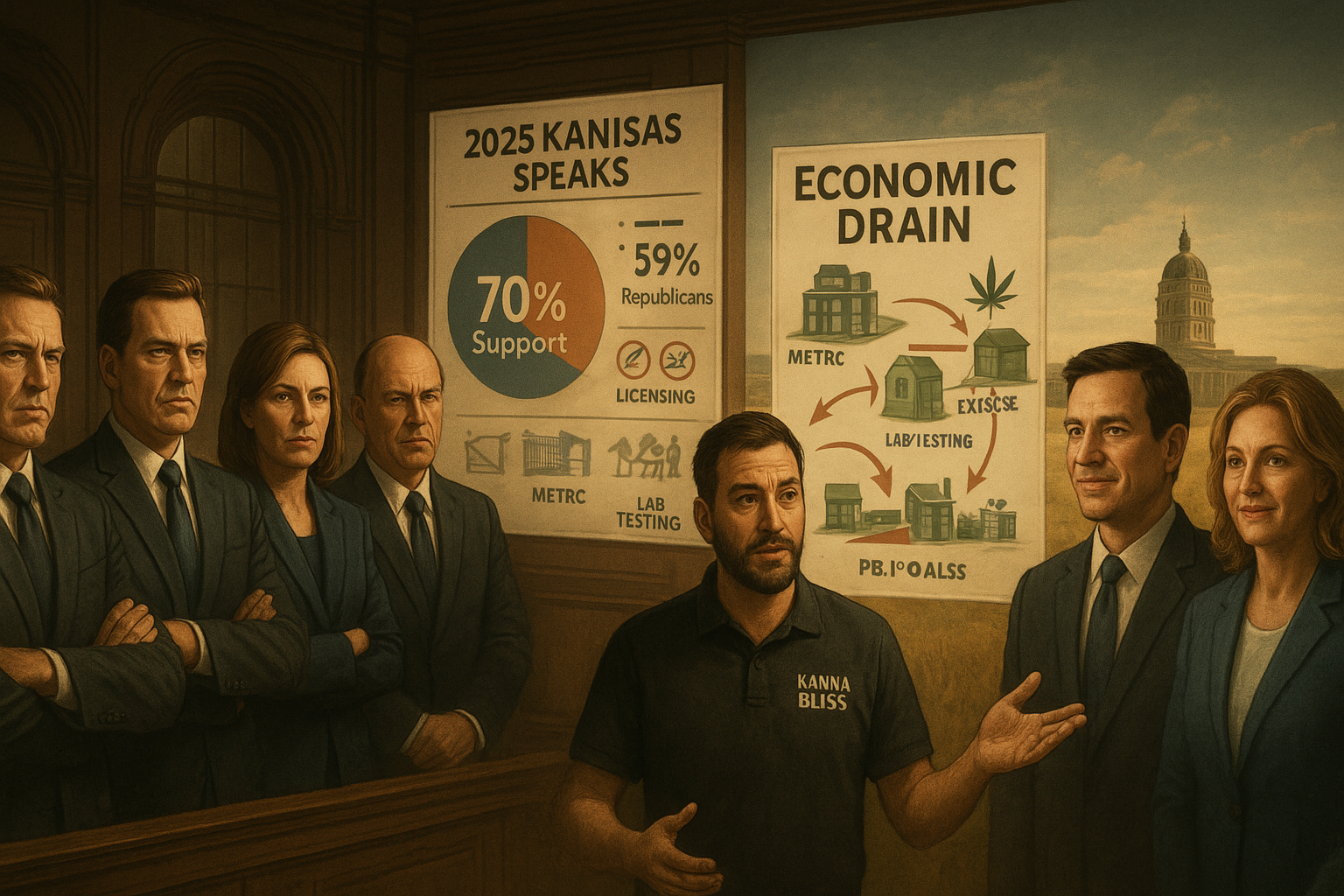
The political math here is harder to ignore than most candidates seem willing to admit. A 2025 Kansas Speaks survey found that 70% of Kansans support medical cannabis legalization - including 59% of self-identified Republicans. That is not a fringe position. For operators and investors watching the Kansas market, this kind of survey data is meaningful context for assessing when, not whether, a regulated market may eventually open; to read more about how adjacent regulated markets have developed and what dispensary operators navigating newer state frameworks have encountered, the operational contrasts are instructive. Kansas, without a licensed framework of any kind, has no seed-to-sale tracking requirements, no compliance infrastructure, no excise tax structure, and no licensing board - the entire regulatory apparatus that would underpin a legal market does not yet exist.
Among the Republican candidates who did respond to press inquiries, the positions ranged from dismissive to ambiguous. Ty Masterson framed the issue as a legislative reality check - "In Topeka there isn't support for it" - which may be accurate as a description of the current statehouse but sidesteps the question of whether that should change. Scott Schwab offered a safety rationale without elaboration. Charlotte O'Hara said simply: "No." Philip Sarnecki expressed opposition to both recreational and medical legalization. On the Democratic side, Ethan Corson and Cindy Holscher both support adult-use and medical legalization; Corson pointed explicitly to tax revenue, Holscher to policy pragmatism.
The Revenue Argument Has Real Weight
Brett Harris, owner of KannaBliss, put the economic case as directly as any operator could. Kansas residents are already spending money on cannabis - they're just spending it in Missouri and Oklahoma. That means sales tax revenue, excise tax revenue, licensing fees, and retail jobs are all leaving the state. In regulated markets, cannabis excise taxes and licensing structures have generated meaningful public revenue; the specifics vary by state, but the general pattern is consistent enough that the "revenue stream" argument Corson made is not theoretical. It reflects what has happened in every state that moved from prohibition to a licensed adult-use or medical framework.
Harris's broader point - that Republican candidates who dismiss the issue are making a political miscalculation - is grounded in the survey data. When a majority of your own party's voters support a policy and you either oppose it or decline to engage with it, that is a positioning problem, not just a policy one. "If you're not a Republican focused on this issue, you're doing yourself a disservice," Harris said. His observation that candidates appear "cannabis uneducated" touches on something the B2B side of this industry has long flagged: cannabis policy debates in legislatures and on campaign trails frequently lag the operational and economic realities that licensed operators, compliance vendors, payment processors, and supply chain companies deal with daily.
What a Kansas Market Would Actually Require
Should Kansas move toward legalization - under any future governor - the build-out of a compliant retail framework would be substantial. States launching new medical or adult-use programs typically require, at minimum: a licensing authority with application and renewal processes, a seed-to-sale tracking system (most states use METRC or a comparable platform), mandatory lab testing with certificate of analysis requirements for every product batch, compliant packaging and labeling standards, age verification protocols at point of sale, and a defined tax structure. None of that infrastructure exists in Kansas today.
For dispensary operators and cannabis technology vendors, a new state market represents a meaningful business opportunity - but also a compliance ramp-up that takes time. Point-of-sale systems need to integrate with whatever tracking platform the state mandates. Wholesale menus and inventory management need to conform to state SKU and packaging rules. Payment processing in cannabis remains complicated nationwide given federal banking restrictions, and a new Kansas market would face the same constraints every other state has encountered. Operators entering a newly licensed market early often gain advantages, but they also absorb the operational friction of building compliance workflows from scratch.
The Political Calculation Going Into November
Harris said he believes candidates who avoid the cannabis issue will feel it at the polls in the general election. That may or may not prove out - Kansas has been a reliably conservative state, and gubernatorial elections turn on more than a single policy question. But the survey data does suggest that a Republican candidate who found a way to engage seriously with medical cannabis, in particular, would not be abandoning their base. They'd be responding to it. The gap between what Republican voters say they support and what Republican candidates are willing to say publicly is, frankly, striking.
For the cannabis business community - operators, compliance firms, retail technology vendors, real estate investors, and anyone else with a stake in whether Kansas eventually opens a licensed market - the primary outcome matters less as a single event than as a signal of trajectory. A Kansas governor who treats cannabis legalization as a legitimate policy discussion is a different regulatory environment than one who won't engage with it at all. The economic pressure Harris described, with Kansas residents driving to Missouri and Oklahoma for products they can't buy at home, will not ease on its own. At some point, that math tends to move legislatures.