
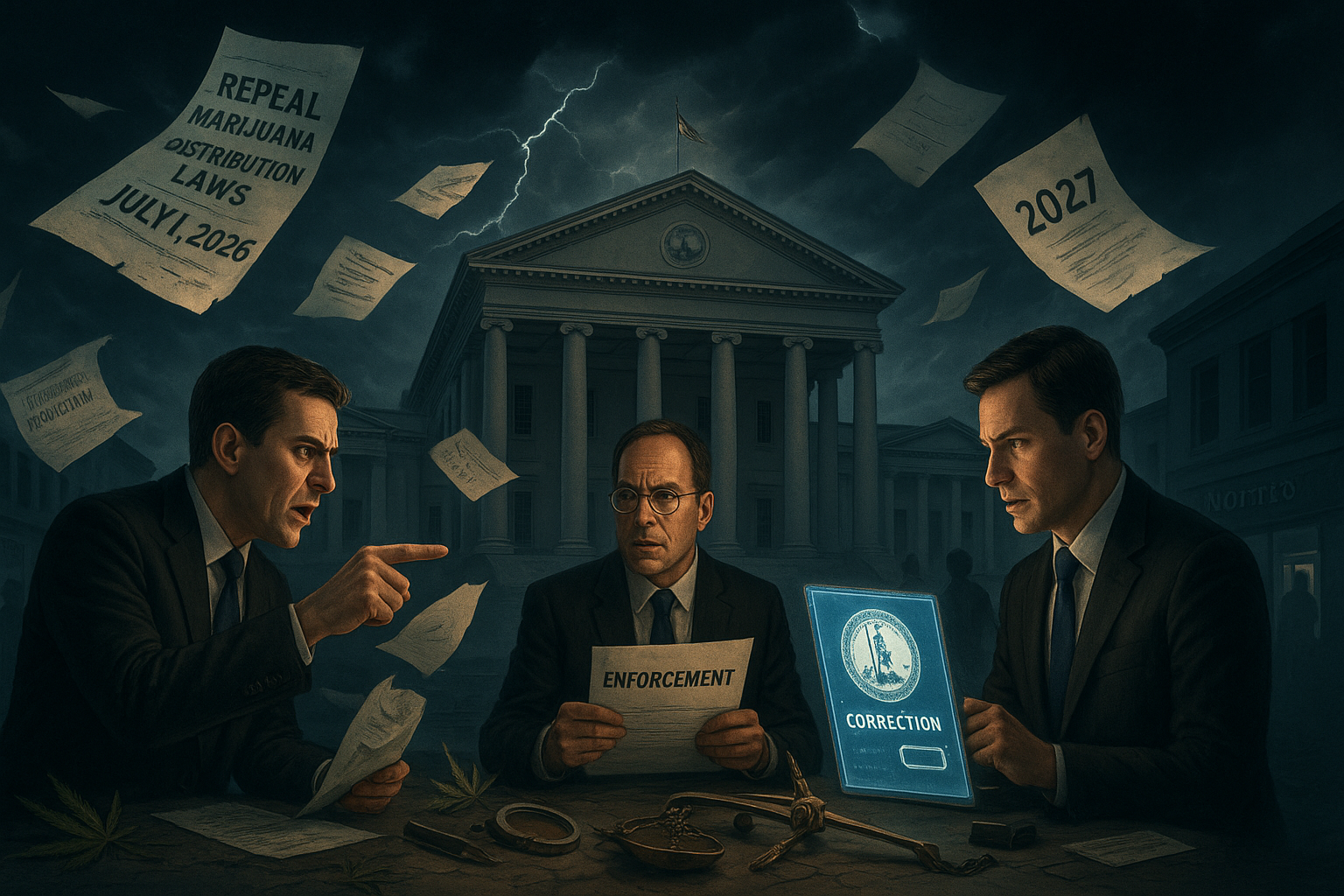
A drafting mistake buried in Virginia's newly enacted state budget has thrown the state's cannabis enforcement framework into serious doubt, prompting prosecutors, legislators, and the state Code Commission to scramble for answers on whether existing marijuana distribution laws were inadvertently repealed as of July 1, 2026 - a full year before the state's licensed retail market is set to open. The budget, passed to authorize recreational cannabis sales starting July 1, 2027, appears to contain language that also wiped out the current prohibitions on distribution and underage possession on the same date. The Code Commission moved Wednesday to post a correction on the state's official legal website, but the underlying ambiguity hasn't been fully resolved.
How a Word Problem Became a Compliance Crisis
The mechanics here matter. Virginia lawmakers authorized up to 350 licensed cannabis retailers to open in July 2027, with accompanying rules on age verification, market competition, and penalties for sales to minors. Standard regulatory architecture - the kind familiar to operators in any adult-use state - would keep existing prohibitions in place until the new system activated. The problem is that separate budget language appears to repeal prior cannabis laws effective July 1, 2026, and the way that passage is written leaves it genuinely unclear which statutes it references. Operators in other regulated states know this kind of drafting gap well; compliance officers at dispensary groups frequently track pending repeal language to avoid exactly this scenario. Tools like IndicaOnline POS Colorado illustrate how point-of-sale infrastructure in mature markets is built around clearly defined legal parameters - when those parameters become ambiguous, every downstream compliance function is compromised.
Williamsburg-James City Commonwealth's Attorney Nate Green put it plainly: "They created a word problem, and word problems go against prosecutors. If it's unclear, we lose." That's not a political statement - it's a basic principle of statutory interpretation. Ambiguous criminal statutes are typically construed in favor of the defendant. Which means that any distribution or underage possession case filed between July 1, 2026, and July 1, 2027, could face a legitimate challenge on the grounds that the underlying prohibition no longer exists. Virginia Beach Commonwealth's Attorney Colin Stolle disagreed, stating publicly that he believes the original laws remain valid and enforceable. Two chief prosecutors, same statute, opposite readings. That's the definition of legal exposure.
What the Code Commission Did - and What It Didn't Fix
By Wednesday afternoon, Del. Marcus Simon, chair of the Code Commission, confirmed that the body had updated the state's legal website to reflect that existing restrictions stay in force until the new provisions take effect in 2027. Simon characterized it as "a fairly routine thing" - the kind of technical correction the Code Commission handles regularly when errors surface before laws become effective. Here's the catch: this one was already effective. The fiscal year turned July 1, and the language was live. Simon acknowledged the correction had to be expedited precisely because the law was already on the books.
What a website update cannot do is insulate a prosecution from challenge. The Code Commission has authority to correct obvious clerical errors, and Simon framed this as exactly that - "an absurd result would have happened" if the original language had been followed literally. But a defendant's attorney doesn't have to accept the Commission's post-hoc interpretation as binding. Courts make that call. The Virginia Association of Commonwealth's Attorneys has been fielding concern from members and is reaching out to relevant parties for formal clarification. A special session of the General Assembly remains on the table as the cleanest legislative fix - restoring statutory clarity through the same body that created the problem.
The B2B Risk Hiding Inside a Legislative Drafting Dispute
For the cannabis industry watching Virginia's build-out toward its 2027 retail launch, this episode carries a harder lesson. Licensing timelines, compliance obligations, and investment decisions are all downstream of clean statutory language. Operators preparing to enter Virginia - whether as prospective licensees, real estate partners, technology vendors, or wholesale suppliers - have been planning around a July 2027 activation date and a defined regulatory structure. A gap year of legal uncertainty doesn't delay that date, but it does raise questions about enforcement environment, market conditions on opening day, and whether any black-market activity that expands during the ambiguous period will complicate the licensed market's early performance.
There's also a consumer safety dimension that gets lost when the debate stays at the level of prosecutorial strategy. Age-verification requirements, product testing mandates, and compliant packaging rules are all features of the licensed system that won't exist until 2027. If distribution were genuinely unregulated in the interim - which, to be clear, the Code Commission says it is not - none of those safeguards would apply. No certificate of analysis requirements. No seed-to-sale tracking. No excise tax collection. No license accountability. That gap, even theoretical, is precisely why ambiguous cannabis legislation carries stakes well beyond a courtroom argument about statutory interpretation.